

Mention stevia in a formulation meeting and most food scientists immediately think about one thing: sugar reduction. For decades, stevia has been one of the food industry’s most important tools for helping manufacturers reduce sugar while maintaining sweetness, supporting clean-label initiatives, and responding to consumer demand for healthier products. Its emerging role in savory foods, however, is beginning to challenge that traditional perception.
Ongoing ingredient innovation is proving stevia-based technologies have applications far beyond sweetness. Stevia has grown rapidly in popularity as a natural taste enhancer and flavor modifier, prompting food and beverage manufacturers to explore its potential across a broader range of applications. In particular, as food companies work to overcome the sensory challenges associated with reduced-sodium formulations, some are beginning to investigate how technologies originally associated with sweet applications can help improve taste in savory foods.
The opportunity is especially relevant given the scale of the global sodium problem. According to the World Health Organization (WHO), the global average adult sodium intake is approximately 4,310 mg per day, more than double the WHO recommended limit of 2,000 mg per day. An estimated 1.89 million deaths each year are associated with excessive sodium consumption and diet-related cardiovascular disease.
Despite decades of public health initiatives, the WHO’s 2013 goal of reducing global sodium intake by 30% by 2025 remains unmet — a target now extended to 2030. Governments continue to introduce sodium-reduction initiatives and front-of-pack labeling requirements, while consumers are increasingly seeking healthier food options. According to an Innova Market Insights 2024 consumer survey, nearly half (48%) of global consumers believe reduced-sodium, reduced-sugar, and reduced-fat products are healthier than their traditional counterparts, and limiting salt intake has become one of consumers’ most common dietary priorities.
The demand for sodium reduction is clear. The challenge is that consumers still expect foods to deliver the same satisfying flavor experience. For manufacturers, the question is no longer simply how to remove sodium — it is how to reduce it without sacrificing taste.

The Flavor Barrier to Sodium Reduction
To understand why sodium reduction remains one of food formulation’s most persistent challenges is to understand that salt does much more than deliver saltiness. It enhances flavor perception, amplifies savory notes, contributes to mouthfeel, and helps create the satisfying sensory experience consumers expect from foods ranging from condiments and snacks to soups and prepared foods.
To compensate, many manufacturers rely on potassium chloride (KCl), the most widely used sodium replacement ingredient available today. While effective from a nutritional standpoint, potassium chloride introduces a different challenge: bitterness, metallic notes, and lingering astringency that can significantly impact consumer acceptance. In fact, many formulators find that once sodium reduction exceeds approximately 20%, sensory quality begins to deteriorate rapidly.
This creates a difficult balancing act. Manufacturers need to reduce sodium to satisfy regulatory targets, front-of-pack labeling requirements, and consumer expectations. Yet every step toward lower sodium increases the risk of compromising flavor.
Beyond Sweetness: HOWTIAN’s SoPure™ Flevia
Stevia’s reputation was built on sugar reduction. But ongoing research into stevia-derived flavor technologies is revealing a broader opportunity to help manufacturers address sensory challenges that extend well beyond sweetness. In reduced-sodium formulations, stevia-derived flavor technologies may be applied to mitigate bitterness, restore flavor balance, enhance savory character, and rebuild the taste profile consumers expect.
Sensory modulation is an essential step in rebuilding that taste profile. Unlike traditional salt replacers, sensory modulators do not attempt to replace sodium directly. Instead, they help manage the flavor consequences of reducing it. One example of this approach is HOWTIAN’s SoPure™ Flevia, a natural flavor management solution that is derived from stevia and designed to improve overall sensory performance across a range of food and beverage applications.



Unlike conventional stevia ingredients used primarily for sweetness, Flevia is formulated to help manage off-notes, enhance desirable flavor characteristics, and improve overall flavor balance. It also offers manufacturers a natural alternative to artificial flavor modifiers, aligning with growing consumer demand for more recognizable, plant-derived ingredient solutions.
Through ongoing application development, HOWTIAN researchers identified the potential for Flevia to address several common sensory challenges associated with reduced-sodium formulations. In savory systems, the result is a more balanced flavor experience without increasing sodium levels.
Sample Application: Salt-Reduced Ketchup
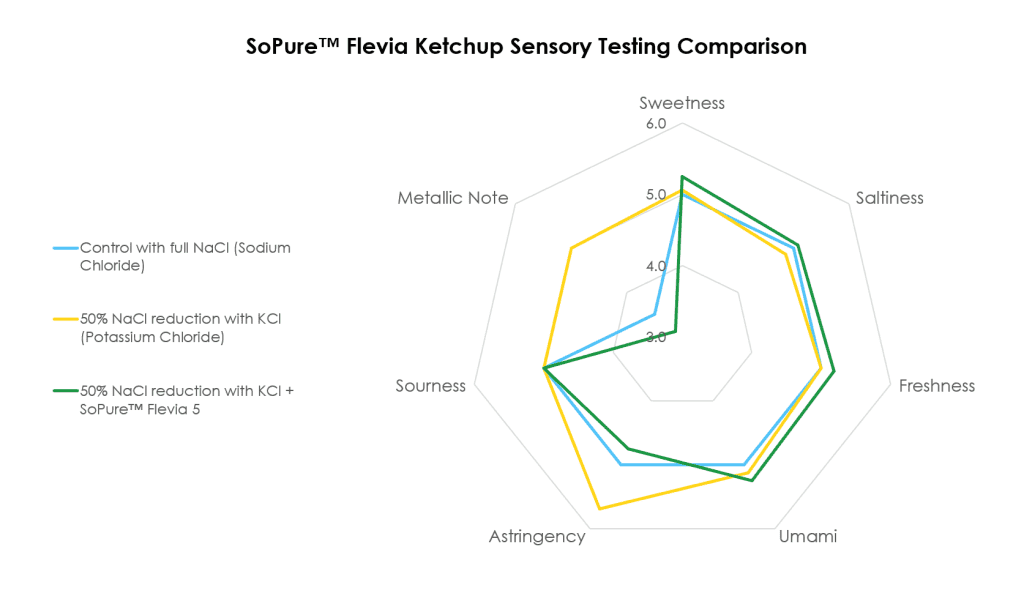
For its demonstration, HOWTIAN created a 50% salt-reduced ketchup formulation. Using just 0.005% SoPure™ Flevia 5, researchers successfully masked the bitterness and astringency introduced by potassium chloride (KCl) while enhancing umami perception and overall flavor richness.
Sensory evaluations found that the reduced-sodium formulation delivered significantly stronger overall flavor acceptability than the control group with full sodium chloride (NaCl). As seen in the test results below, the product demonstrated a fuller, rounder flavor profile, improved mouthfeel, and sensory performance approaching that of a full-salt benchmark.
The implications extend well beyond ketchup. HOWTIAN is currently exploring applications across additional savory categories, including seasoning systems, soup bases, meat products, and bakery applications, reflecting growing industry demand for solutions that enable deeper sodium reduction without compromising consumer satisfaction.
The Next Frontier for Stevia
As sodium reduction targets become more aggressive around the world, manufacturers will need more than traditional salt replacement strategies. Success will increasingly depend on preserving the sensory experience consumers expect while achieving meaningful nutritional improvements, a reality that is expanding the role of ingredients once associated with entirely different challenges.
For stevia, the future may no longer be defined exclusively by sugar reduction. Instead, its next chapter may be helping manufacturers solve one of the food industry’s most persistent challenges of delivering lower-sodium foods that also deliver on taste.
For HOWTIAN, that future is already taking shape. SoPure™ Flevia is not a concept under exploration. It is a deployed, proprietary platform helping food scientists around the world remove sodium without removing the flavor consumers love.